

If you are applying for student finance for the 2026/27 academic year, the amount of Maintenance Loan you receive can make a major difference to your student budget.
The important thing is that there is no single Maintenance Loan amount for everyone. Your entitlement depends on where you live while studying, your household income and, in some circumstances, whether you receive benefits, have dependants or are in your final year.
For students in England, the maximum standard Maintenance Loan for 2026/27 is £10,830 if you live away from home outside London. It rises to £14,135 if you live away from home and study in London. If you live with your parents, the maximum standard rate is £9,118.
Those figures are useful, but they do not answer the question most students actually have:
How do I make sure I receive the highest amount I am entitled to?
The answer is to get the income assessment right, give SFE the information it needs, update the application when your circumstances change and check whether your household income has fallen enough to justify a current-year assessment.
Important: This guide covers Student Finance England and the 2026/27 academic year. Student finance arrangements in Scotland, Wales and Northern Ireland are different.
What is the maximum Maintenance Loan in 2026/27?
For full-time undergraduate students in England who are not entitled to benefits, the standard 2026/27 rates are:
| Your living arrangement | Maximum Maintenance Loan | Minimum Maintenance Loan |
|---|---|---|
| Living with parents | £9,118 | £4,013 |
| Living away from home, outside London | £10,830 | £5,048 |
| Living away from home, in London | £14,135 | £7,039 |
| Studying overseas as part of a UK course | £12,403 | £5,996 |
These are the published maximum and minimum rates for 2026/27.
There are higher maximum rates for full-time students who are eligible for certain benefits. These rise to £10,757 for students living at home, £12,345 for students living away outside London and £15,415 for students living away in London.
The first point to understand is therefore simple:
Your maximum depends partly on your living arrangement before household income is even considered.
If two students have exactly the same household income but one studies in London while living away from home and the other studies outside London, their maximum loan rates are different.
The £25,000 household-income starting point
For most dependent students who started their course on or after 1 August 2016, the income assessment begins with a household income of £25,000.
At or below £25,000, the published 2026/27 tables show the maximum Maintenance Loan for the relevant living arrangement.
Above £25,000, the loan is reduced according to the income-assessment rules.
For students not entitled to benefits, the 2026/27 calculation reduces the Maintenance Loan by:
- £1 for every £6.54 of total income above £25,000 for students living with parents.
- £1 for every £6.36 above £25,000 for students living away from home and studying in London.
- £1 for every £6.47 above £25,000 for students living away from home and studying outside London.
The reduction continues until the relevant basic rate remains.
This gives you a useful way to understand the calculation without treating the household-income table as a mystery.
Example: £45,000 household income
Suppose a student lives away from home outside London and the relevant household income is £45,000.
The maximum loan is £10,830.
The published 2026/27 table shows an entitlement of £7,739 at £45,000 household income.
So the difference from the maximum is:
£10,830 − £7,739 = £3,091
That does not mean the student has been “charged” £3,091. It means the income assessment reduces the amount of Maintenance Loan available by that amount compared with the maximum.
The same £45,000 household income produces different amounts depending on where the student lives:
| Living arrangement | Loan at £45,000 income |
|---|---|
| With parents | £6,060 |
| Away outside London | £7,739 |
| Away in London | £10,991 |
That is why copying another student’s loan amount and assuming it should be the same for you can give you the wrong expectation.
How household income is assessed
For a dependent student, SFE normally assesses parental income.
For 2026/27, the normal reference tax year is 2024/25. SFE explains that it uses this year because it is the relevant income information available for the assessment.
The calculation can include the income of a relevant partner of the student’s parent.
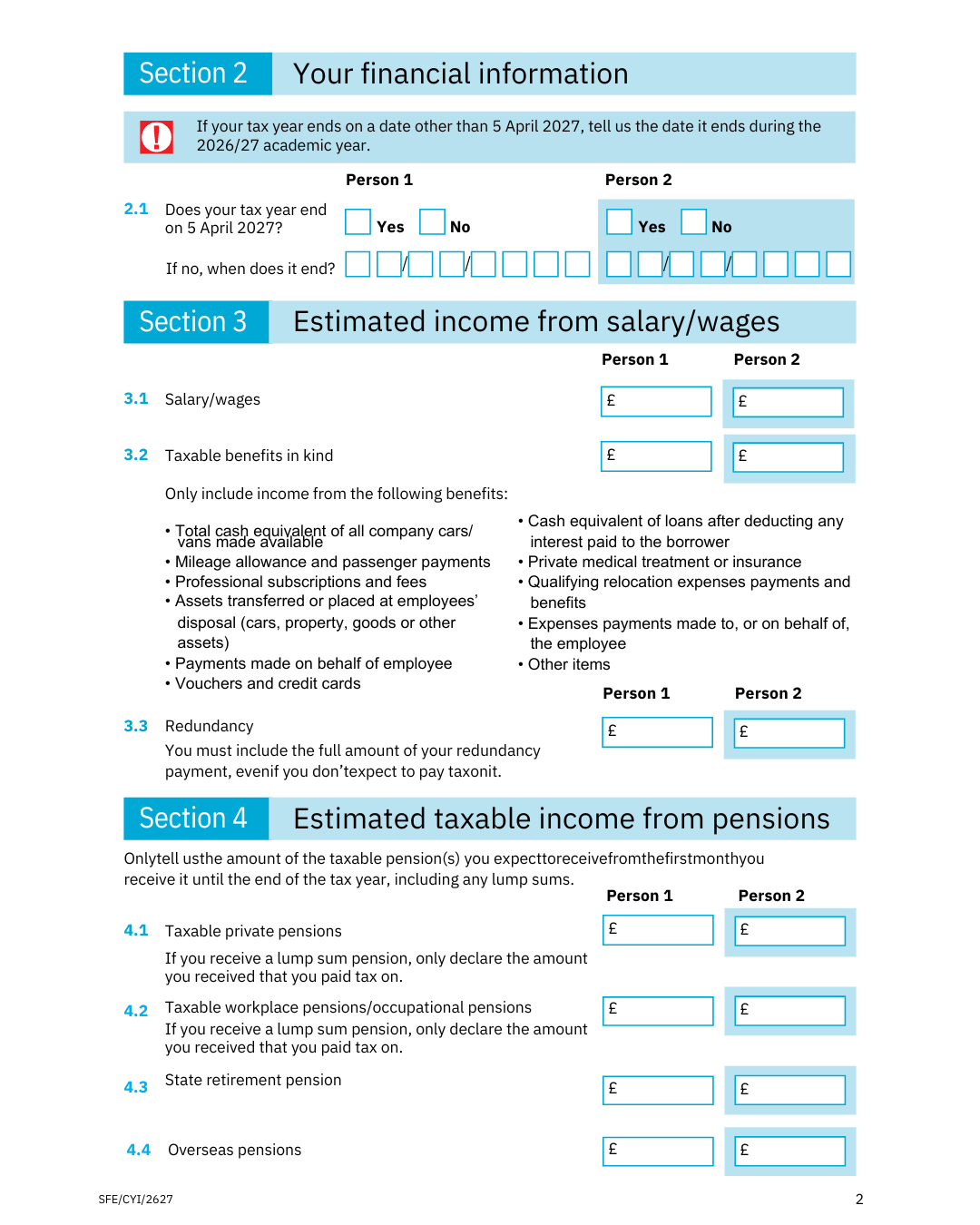
SFE also allows certain deductions and allowances when working out residual household income. The 2026/27 guidance refers to private pension contributions, additional voluntary contributions, employment-related costs and £1,130 for each other child who is wholly or mainly financially dependent on the parent.
This is one reason you should not try to estimate your entitlement simply by looking at one parent’s salary.
The relevant calculation is more detailed than:
parent’s salary = household income.
It is a household-income assessment using the rules set by Student Finance England.
Which parent’s income is used?
If your parents are separated or divorced, SFE normally uses the income of the parent you are financially dependent on, including the income of that parent’s partner where applicable.
You do not normally need to provide income information from the parent you are not financially dependent on or have less contact with.
This matters because students sometimes assume that SFE automatically combines the incomes of both biological parents.
That is not how the assessment is described in the 2026/27 guidance.
If your family circumstances are complicated, use the official assessment rules rather than trying to choose the income figure that produces the largest loan.
What if your parents cannot afford the expected contribution?
This is where the difference between loan assessment and family budgeting becomes important.
SFE uses household income to determine how much Maintenance Loan a dependent student can receive.
That does not mean SFE collects a parental contribution and sends it to the student.
If your assessed loan is lower than the maximum, your family may still need to decide how to cover the difference between your actual living costs and the funding available.
The government’s own living-cost guidance says students may need to make up the difference through sources such as parental or partner support, part-time employment, savings, university bursaries, scholarships or local-authority support.
A better student budget therefore has two separate numbers:
1. Your assessed Maintenance Loan
2. Your actual annual living cost
The gap between those numbers is the amount you need to plan for.
What if household income has fallen since 2024/25?
This is one of the most important opportunities to check.
Imagine your parents’ household income was £60,000 in 2024/25 but has fallen substantially because of redundancy, reduced working hours, a business downturn or another significant change.
Using only the old figure could make your expected Maintenance Loan look lower than it may ultimately be.
For 2026/27, SFE says that if household income has dropped by 15% or more, parents can ask for a current-year income assessment. The parents still need to provide the normal 2024/25 information first.
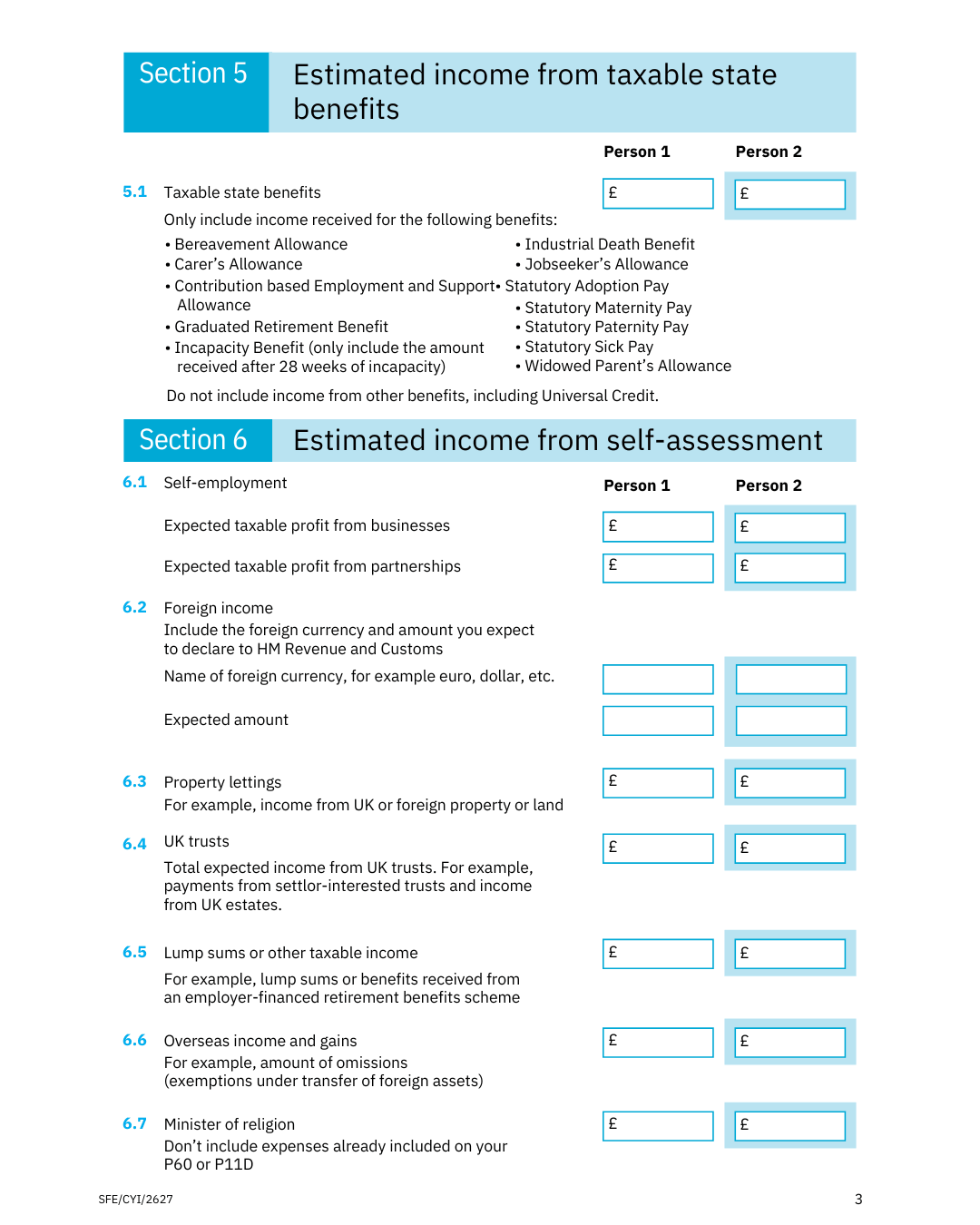
The current-year assessment uses estimated income for 2026/27.
Example
Suppose:
- 2024/25 household income: £50,000
- Expected 2026/27 household income: £42,000
The fall is:
£50,000 − £42,000 = £8,000
Percentage reduction:
£8,000 ÷ £50,000 × 100 = 16%
Because the expected reduction is at least 15%, the family can ask SFE to consider a current-year income assessment.
This is not an automatic guarantee of a particular loan amount. SFE still applies its assessment rules to the revised income information.
But it is an important route to investigate when the family’s financial circumstances have materially changed.
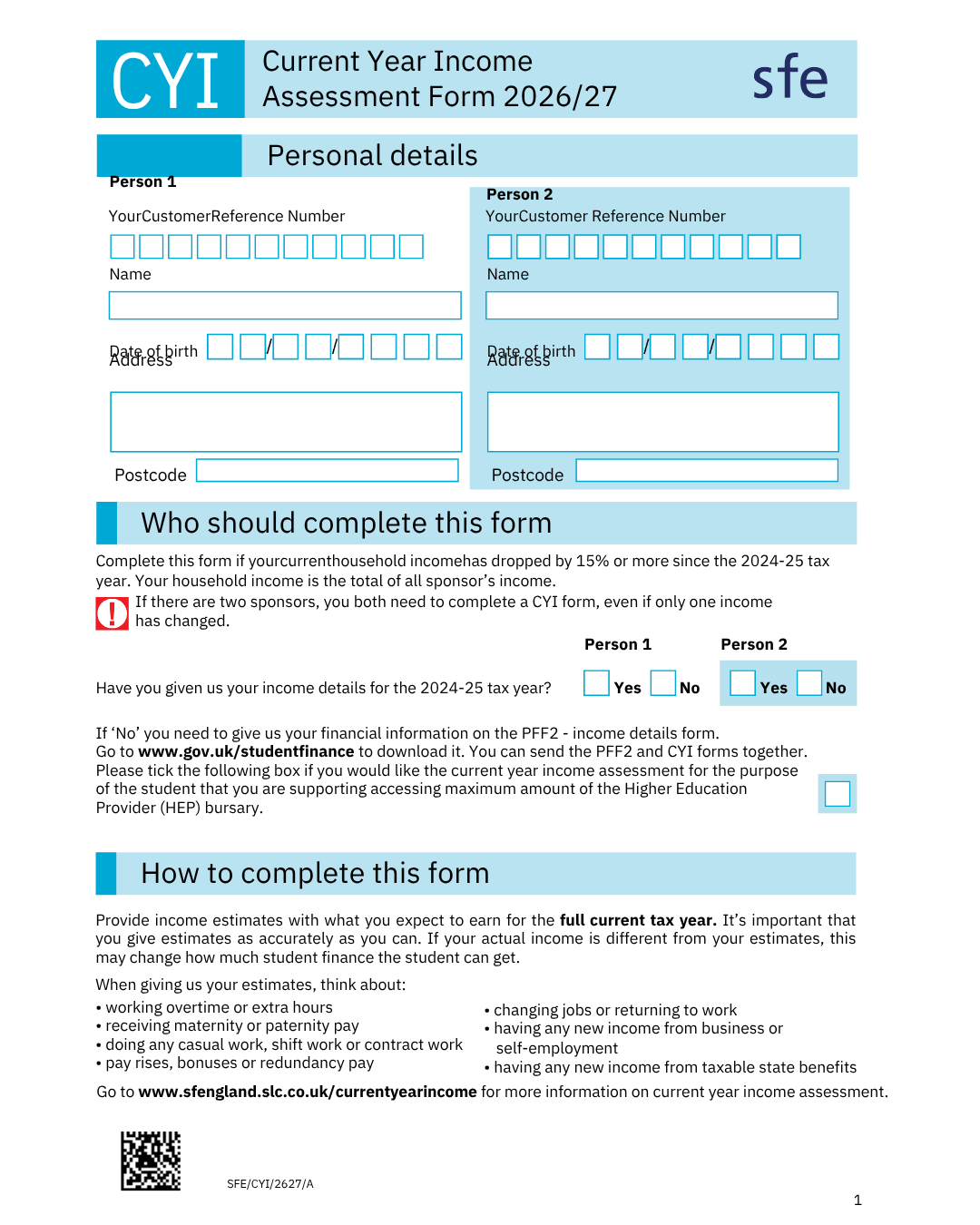
Use the official 2026/27 income forms when necessary
SFE provides a PFF2 Assessment of Financial Circumstances form for parents and partners.
The 2026/27 PFF2 specifically asks for relevant 2024/25 financial information. It also explains the current-year income route where household income has fallen by at least 15%.
The official form is particularly useful when online submission is not possible or when SFE asks for supporting information.
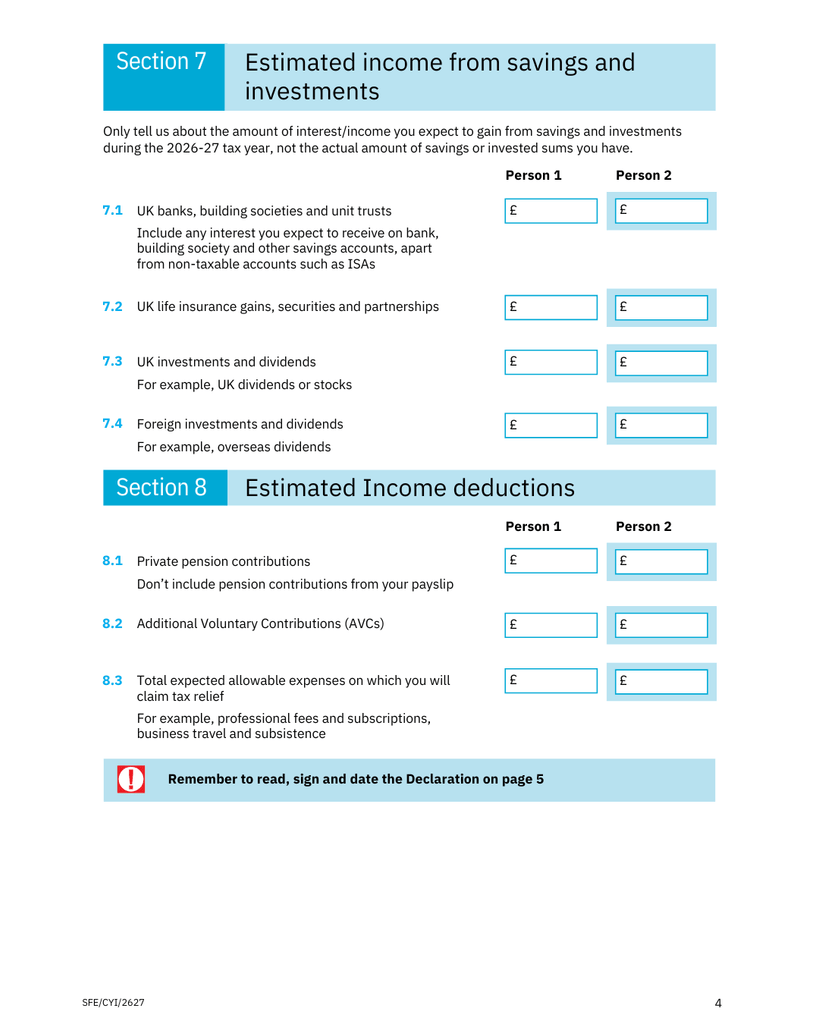
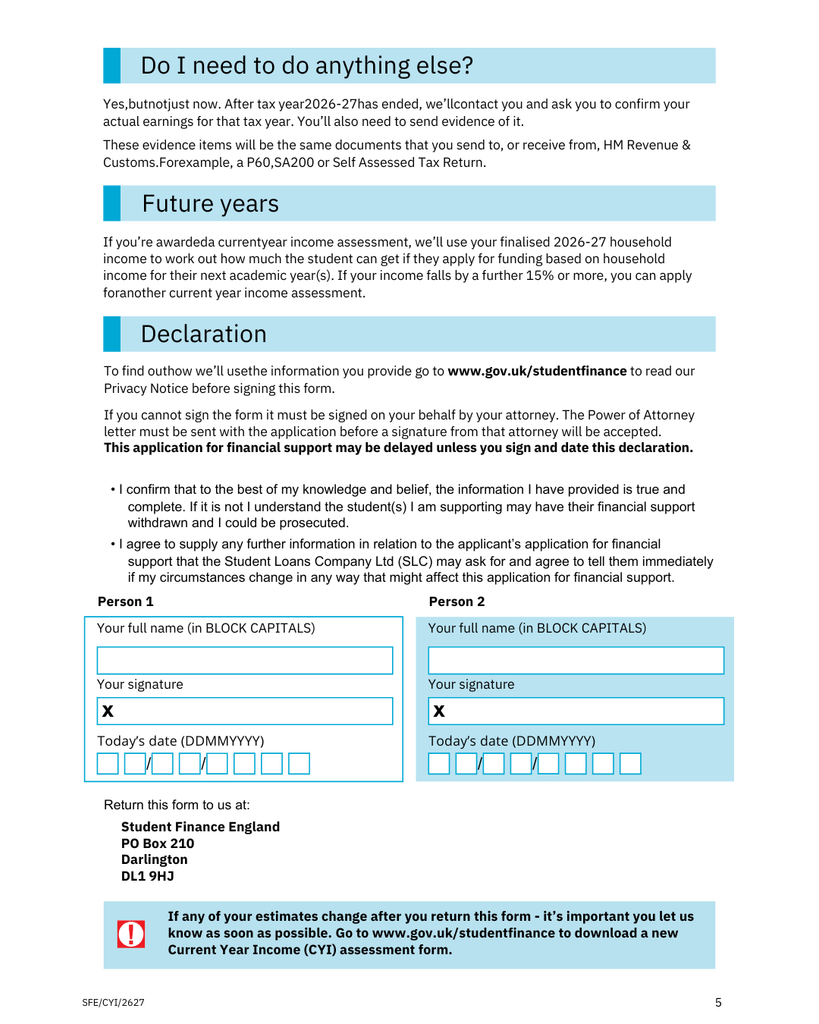
There is also a separate Current Year Income Assessment Form for 2026/27. The form says it should be used when current household income has dropped by 15% or more compared with 2024/25.
Do not estimate the percentage fall casually. Use the figures the family can reasonably support.
How to apply for the maximum Maintenance Loan
There is no legitimate trick that bypasses the household-income rules.
The practical approach is to make sure your application accurately reflects your circumstances.
Step 1: Confirm that you are applying through Student Finance England
The figures in this article apply to students covered by the England system.
If you normally live in Scotland, Wales or Northern Ireland, use the relevant national student-finance system instead.
Step 2: Confirm where you will live
Decide whether you will:
- live with your parents;
- live away from home outside London; or
- live away from home in London.
Your living arrangement directly affects the maximum Maintenance Loan.
If you change where you live during your course, update your student-finance information because the amount available can change.
Step 3: Give the correct household-income information
For 2026/27, dependent students normally need the relevant 2024/25 household-income information.
Make sure the parent or partner completes the required income information rather than leaving the assessment incomplete.
If the required parental information is not supplied, you may not receive the full amount of Maintenance Loan available to you.
Step 4: Check whether the 15% current-income rule applies
If household income has fallen by at least 15%, investigate the current-year income assessment.
Do not simply leave the original income figure in place and assume nothing can be done.
Step 5: Check the official calculation
Use the government’s student finance calculator as a final sense-check.
The calculator covers 2026/27 undergraduate applications and asks about factors including household income and study circumstances.
Step 6: Keep your application updated
Your circumstances can change.
For example, changing your course or moving from living with your parents to living elsewhere can affect your student-finance position.
The government advises students to keep their details up to date throughout their course.
Apply early if you need the money for rent
The formal late-application window is not the same thing as a sensible financial-planning deadline.
For 2026/27, students can still apply up to nine months after the start of the academic year, but late applications can initially receive only the minimum amount while household-income checks are completed.
For September 2026 starters, Student Loans Company encouraged new students to apply by 15 May 2026 so funding could be arranged for the beginning of the course.
If your rent is due before your full assessment is complete, this distinction matters.
A student who has technically applied within the allowed period can still face a short-term cash-flow problem.
How Maintenance Loan payments arrive
Full-time students normally receive Maintenance Loan payments in three instalments, generally at the start of each term.
You must register at your university or college before the first payment can be made. SFE says that, after registration is confirmed, the payment can take up to five working days to reach the student’s bank account, depending on the bank.
This creates an important budgeting rule:
Do not treat the annual Maintenance Loan as though it arrives in your account as one lump sum.
Plan around the actual payment dates shown in your Student Finance Notification of Entitlement.
What if the maximum loan still does not cover your rent?
This is where a realistic student budget matters.
The maximum loan is not necessarily enough to cover every student’s living costs. The government’s living-cost guidance explicitly recognises that even the maximum Maintenance Loan may not cover all living costs.
Start with the costs that are hardest to change:
- Rent
- Essential bills
- Food
- Transport
- Course-related costs
- Essential communications
- Emergency reserve
Then compare those costs with the amount available from your Maintenance Loan.
Example budget
Suppose a student has an annual Maintenance Loan of £10,830.
If annual essential living costs total £13,200:
£13,200 − £10,830 = £2,370
The student needs a plan for the remaining £2,370.
That does not automatically mean borrowing more.
Possible funding sources include university bursaries, scholarships, part-time work, savings or family support, depending on the student’s circumstances.
The key is to identify the gap before the academic year starts.
Do not confuse the Maintenance Loan with free money
A Maintenance Loan is a loan.
The government states that Maintenance Loans have to be repaid under the applicable repayment arrangements.
That makes it sensible to think about the loan as part of your overall student-finance position rather than treating the maximum available amount as a spending target.
If you qualify for additional non-repayable support, such as certain grants, bursaries or scholarships, check those options separately.
Final-year students need to check their rate
Students in their final year can receive a lower maximum Maintenance Loan because the normal payment period does not extend beyond the end of the final academic year.
For 2026/27, the published maximum final-year rates for continuing full-time students are:
- £8,579 living with parents
- £10,242 living away outside London
- £13,096 living away in London
- £11,103 for a year of study abroad
If you are budgeting for your final year, do not simply copy the figure from your previous year.
Other students in the same household
If you have a brother, sister or parent who is also receiving student finance, special rules can apply.
SFE explains that the household contribution is worked out before it is shared between eligible students in the family. In normal circumstances, it is shared equally, although there are circumstances where it can be divided differently.
This is another reason why a family’s calculation may not match a simple online estimate.
Could you be an independent student?
Not every student under 25 is automatically assessed using parental income.
SFE lists circumstances in which a student can be treated as independent. These include being 25 or over at the start of the academic year, having care of a child, having been married or in a civil partnership, having no living parents, supporting yourself for at least three years, being permanently estranged from your parents or meeting certain care-related conditions.
Simply moving out of your parents’ home does not by itself make you independent.
Likewise, a disagreement with your parents or their refusal to provide financial support does not automatically create independent-student status.
If you believe you meet one of the official conditions, check the evidence requirements before submitting your application.
A simple 2026/27 Maintenance Loan checklist
Before submitting or finalising your application, check:
- Are you applying through the correct student-finance system?
- Is your course eligible?
- Where will you live during the academic year?
- Is your household-income information complete?
- Is the correct 2024/25 income being used?
- Has household income fallen by at least 15%?
- Does a current-year income assessment need to be considered?
- Have you checked whether you qualify as an independent student?
- Are there other students in your household?
- Are you in your final year?
- Have you checked the official calculator?
- Are your bank details correct?
- Have you registered with your university before expecting the first payment?
Getting these points right will not manufacture a larger entitlement. It does something more useful: it reduces the risk that you receive less than the amount for which you actually qualify.
The practical way to maximise your 2026 Maintenance Loan
The phrase “maximise your Maintenance Loan” can make the process sound like there is a loophole to discover.
There isn’t.
The legitimate approach is much simpler:
1. Apply for the correct living arrangement.
2. Give complete and accurate household-income information.
3. Make sure the relevant parent or partner provides their information.
4. Check whether the 15% current-income assessment applies.
5. Check independent-student status if your circumstances genuinely meet the rules.
6. Update SFE when your circumstances change.
7. Use the official calculator to check the expected amount.
8. Budget against the actual instalment dates rather than the annual figure.
9. Find the funding gap before rent and other bills become due.
That is the safest way to approach the 2026/27 system.
The maximum standard Maintenance Loan outside London is £10,830, but your own entitlement may be lower or, in certain circumstances, higher. The figure that matters is the amount SFE assesses for your particular circumstances.
And if that amount still does not cover your cost of living, treat the shortfall as a separate budgeting problem. University bursaries, scholarships, part-time work, savings and family support can all form part of that plan where available.
FAQ section
1. What is the maximum UK Maintenance Loan for 2026/27?
For students covered by Student Finance England and not entitled to benefits, the maximum is £9,118 when living with parents, £10,830 when living away outside London and £14,135 when living away in London.
2. What household income gives you the maximum Maintenance Loan?
For most dependent students covered by the standard assessment, household income of £25,000 or less qualifies for the maximum rate for the relevant living arrangement.
3. Does my parents’ income affect my Maintenance Loan?
Yes, if you are a dependent student and your funding is subject to household-income assessment. SFE normally uses relevant parental household income for the calculation.
4. Which tax year is used for the 2026/27 Maintenance Loan?
For 2026/27, SFE normally uses household-income information from the 2024/25 tax year.
5. What if my parents’ income has fallen since 2024/25?
If household income has fallen by at least 15%, the family can request a current-year income assessment. The original 2024/25 information still needs to be provided.
6. Can I get the maximum Maintenance Loan if my parents refuse to support me?
Not simply because they refuse to provide financial support. SFE has specific rules for independent-student status, and parental refusal alone does not establish independence.
7. Does living in London increase the Maintenance Loan?
Yes. For 2026/27, the standard maximum for a student living away from home and studying in London is £14,135, compared with £10,830 outside London.
8. How is the Maintenance Loan paid?
Full-time students normally receive their Maintenance Loan in three instalments, generally at the start of each term. Registration at the university or college is required before payment can be made.
9. Can I apply late for the 2026/27 Maintenance Loan?
You can generally apply up to nine months after the first day of the academic year, but applying late can mean that you initially receive only the minimum amount while the application is processed.
10. Is the Maintenance Loan enough to cover rent?
Not necessarily. GOV.UK explicitly notes that even the maximum Maintenance Loan may not cover all living costs. Students may need to use other sources such as bursaries, scholarships, savings, employment or family support.